 2026-05-11
Tsaghkadzor is one of the most recognizable tourism destinations in Armenia, whose attractiveness is formed through the combination of several factors simultaneously. The city serves as a center for winter sports, a leisure destination, and a cultural tourism location. Among the city’s main attractions are the Kecharis Monastery Complex, the ropeway, ski infrastructure, as well as the natural environment favorable for recreation. Its close proximity to Yerevan also creates short-term and weekend tourism demand. Together, these factors make Tsaghkadzor not only a seasonal destination, but also a location with recurring tourism demand.
According to the Statistical Committee of the Republic of Armenia, tourism flows in recent years have passed through several distinct stages.
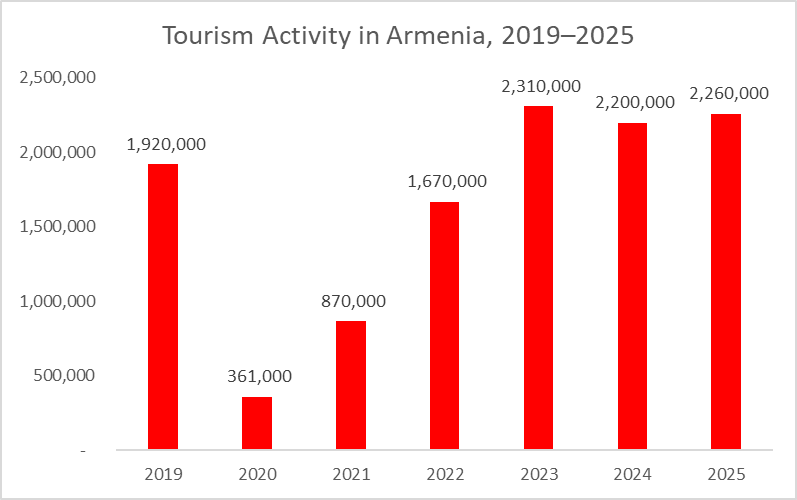
The graph clearly shows that until 2019 Armenia’s tourism market was in a phase of stable growth, reaching approximately 1.9 million tourists annually. During 2020–2021, due to pandemic-related restrictions, the market experienced a sharp decline, with tourism flows decreasing several times and reaching minimum levels. However, beginning in 2022, the market entered a recovery phase, and from 2023 onward rapid growth was recorded, as a result of which the number of tourists not only recovered but also exceeded pre-pandemic levels. In 2024–2025, the market maintained high activity, forming a stable level of more than 2.2 million tourists annually.
From the perspective of the spatial distribution of tourism flows in Armenia, Kotayk region occupies a key position. According to the 2023 “International Visitor Survey,” approximately 31.8% of international tourists visit Kotayk, making the region one of the most active tourism destinations in Armenia. According to the same study, about 33% of tourists visiting Kotayk stay overnight, which is an important indicator for evaluating the market’s economic activity.
In other words, one out of every three tourists generates real hotel demand. Within Kotayk, tourism flows are heavily concentrated in Tsaghkadzor. From an analytical perspective, it can be assumed that approximately 50–55% of tourists visiting the region travel to Tsaghkadzor.
To estimate the approximate size of Tsaghkadzor’s market, the following formula was applied:
Tsaghkadzor overnight tourism flow ≈ Total tourists in Armenia × 31.8% × 33% × 50–55%
This approach makes it possible to move from general tourism flows toward evaluating actual overnight demand, which is more important from the perspective of economic market analysis. At the same time, it is necessary to take into account the current structural characteristics of the market when applying the calculation. In particular, during 2022–2026, due to active construction and infrastructure works in Tsaghkadzor and surrounding areas, a temporary decline in the coefficient of overnight tourists has formed. This decline has largely been caused by technical factors that often interfere with the comfort and quality of the tourism experience.
Considering these factors, an adjustment coefficient is applied:
k = 70% (0.7)
In this case, the formula takes the following form:
Tsaghkadzor overnight tourism flow ≈ Total tourists in Armenia × 31.8% × (33% × 0.7) × 50–55%
This means that the effective share of tourists staying overnight becomes approximately 23%.
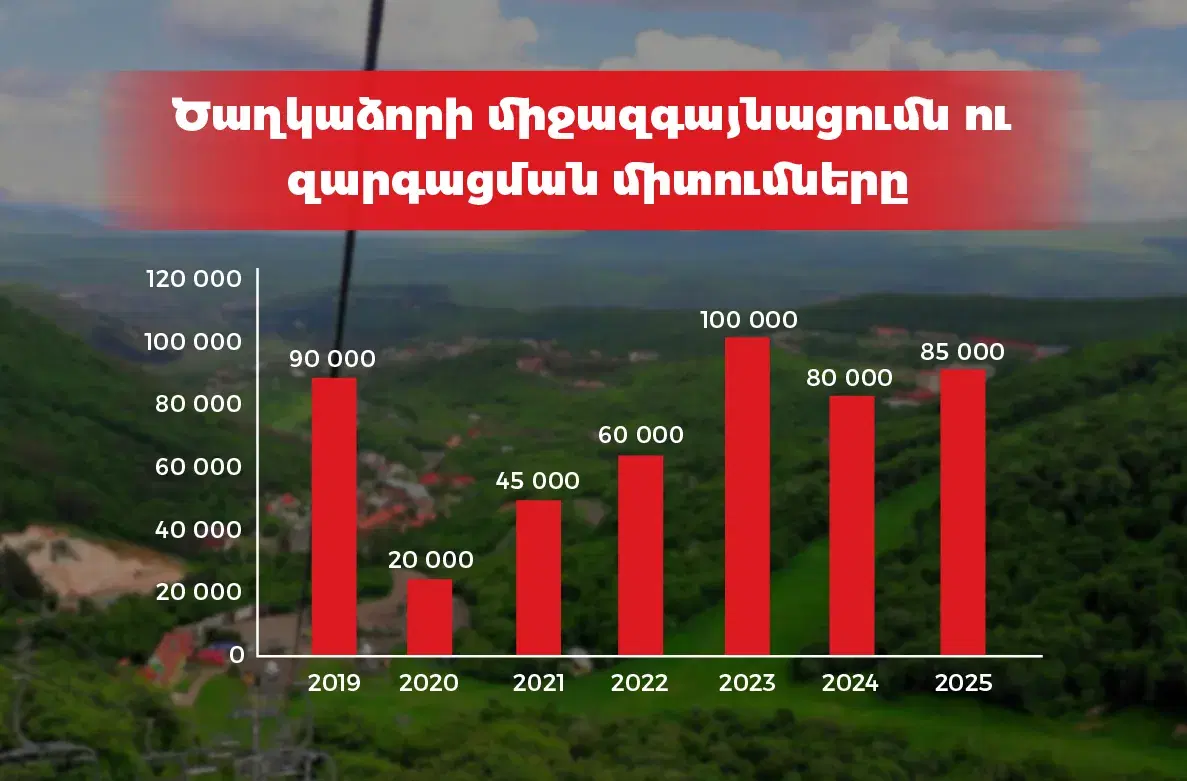
The graph below presents the annual volume of hotel service demand in Tsaghkadzor’s market calculated using this formula.
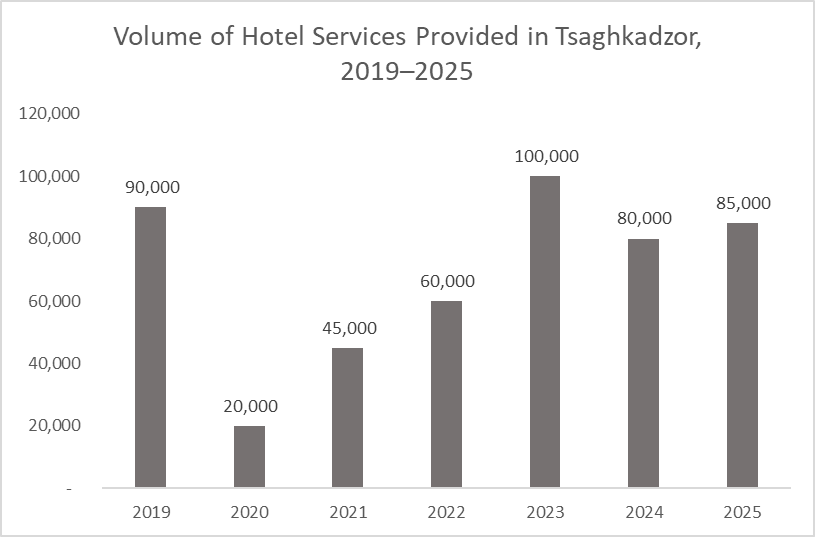
This means that the market is currently operating significantly below its theoretical potential due to:
At the same time, it is important to note that this reduced coefficient is temporary in nature.
In recent years, Tsaghkadzor has entered an active development phase characterized by both construction activity and infrastructure improvements. The city is witnessing intensive growth in residential and hotel projects, including traditional hotels, apart-hotels, and multifunctional complexes. This contributes to the expansion of supply and structural transformation of the market.
At the same time, road reconstruction and infrastructure improvement projects are being implemented, increasing the city’s accessibility, reducing travel time, and stimulating the frequency of visits. The urban environment is also improving through the development of public spaces and service infrastructure, enhancing the overall tourism experience. Tsaghkadzor is gradually moving beyond its traditional role as a seasonal resort town and transforming into a multifunctional tourism center.
One of the important drivers of Tsaghkadzor’s expected market activation is the growing interest of international and global brands in the city. This is not merely the arrival of separate projects or new buildings; the presence of such brands can reshape the city’s tourism perception, demand structure, and pace of market development.
International brands bring not only their name, but also an already established customer base. This includes loyal clients as well as tourists who often make travel decisions based on brand trust. As a result, demand for Tsaghkadzor can emerge not from scratch, but through already existing international networks. If tourists trust a well-known hotel, wellness, or entertainment brand, the entry of that brand into Tsaghkadzor itself becomes a reason to visit. This factor is especially important for attracting international tourists, since recognizable brands reduce decision-making risks for foreign visitors.
The involvement of international brands also increases Tsaghkadzor’s visibility in external markets. Brands usually conduct marketing campaigns, organize events, and cooperate with tourism platforms, agencies, and media channels. As a result, Tsaghkadzor begins to position itself not only as a local or regional resort, but as a tourism destination with broader international recognition. Events, festivals, sports, and entertainment activities can become important branding tools for the city. They create additional reasons to visit beyond the traditional winter season.
One of Tsaghkadzor’s main challenges is seasonality. Traditionally, the market is most active during winter ski season, while demand decreases during the rest of the year. However, new branded projects and entertainment infrastructure can reduce dependence on winter tourism. Wellness complexes, casinos, events, concerts, spa, and entertainment services can attract visitors during spring, summer, and autumn as well.
The activation of the summer season is particularly important. Tsaghkadzor’s climate, nature, and isolated environment already have sufficient potential to generate summer demand, but additional attractions such as events, entertainment, wellness services, and high-quality hospitality are necessary. The same applies to nightlife. If active restaurant, entertainment, and event formats emerge in the city, the duration of tourist stays may increase, contributing not only to hotel occupancy but also to the activation of the entire service chain.
Tsaghkadzor is one of the few cities in Armenia whose combination of hospitality infrastructure, tourism facilities, and natural environment enables it to host not only traditional tourist flows, but also international, sports, and cultural events. The city already possesses an established resort environment, hotel infrastructure, experience in sports-related facilities, and the potential to organize events throughout different seasons of the year. These factors create a strong foundation for attracting larger and more multifunctional events. Particularly important is the fact that such events can generate additional demand not only during the winter season, but also throughout the rest of the year.
In this context, it is entirely possible that in the coming years new large-scale projects will be developed specifically in Tsaghkadzor, including:
Such developments could significantly increase the city’s international visibility and accelerate its transformation into a year-round multifunctional tourism center.
The analysis shows that despite the current construction and infrastructure limitations, Tsaghkadzor’s tourism market is already generating stable and measurable overnight demand. At the same time, the market is currently in a transitional phase where short-term limitations are expected to transform into long-term advantages in the form of improved infrastructure, higher-quality supply, and the involvement of international brands. As a result, Tsaghkadzor has all the prerequisites necessary to transform into a year-round multifunctional tourism center with rapidly growing demand and strong development potential.
Data sources: Tourism Committee of the Ministry of Economy of the Republic of Armenia, Statistical Committee of the Republic of Armenia.
Processed and supplemented by RED Invest Group.


