 2026-06-03
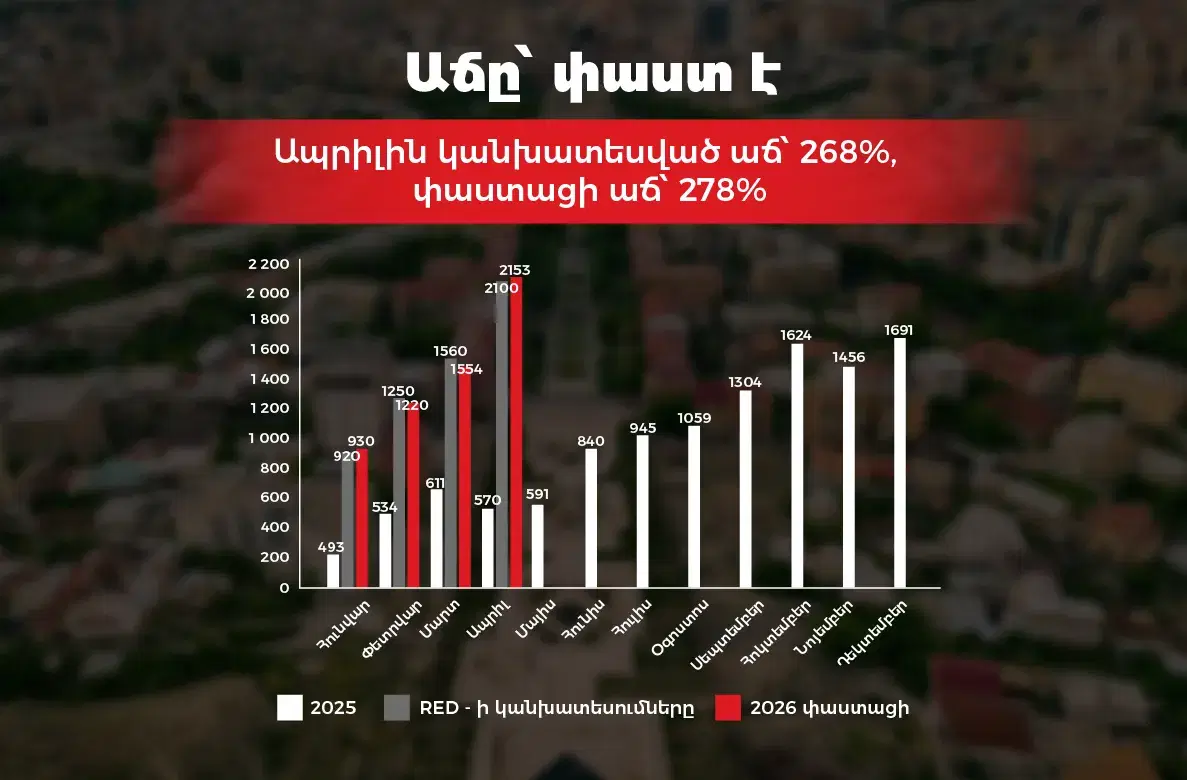
In the first four months of 2026, 5,893 transactions were recorded in Armenia’s primary real estate market, compared to 2,208 transactions during the same period in 2025.
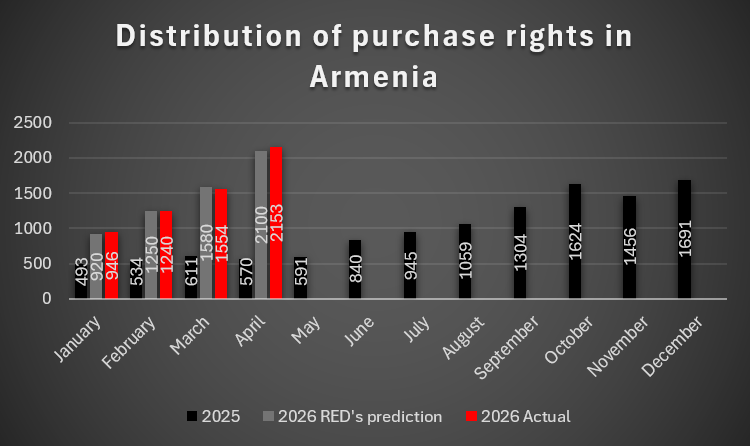
The chart clearly demonstrates the key indicators for the first four months:
• January-April 2025: 2,208 transactions
• January-April 2026: 5,893 transactions
• Increase: 3,685 transactions
• Annual growth: 167%
A comparison of the data shows that market activity was not driven by a single month, but rather developed throughout the entire period. While the market recorded an average of approximately 552 transactions per month during January-April 2025, the same figure reached 1,473 transactions in 2026.
Particularly noteworthy is the result recorded in April, when 2,153 transactions were completed, making it the highest-performing month of the first four months of the year. It is significant that the number of transactions recorded in April alone nearly matched the total volume of transactions recorded during the first four months of 2025, highlighting the scale of activity currently observed in the market.
Of the 2,153 transactions recorded in April, 1,108 were registered in Yerevan.
The key indicators for April are as follows:
• Total transactions: 2,153
• Yerevan: 1,108 transactions
• Yerevan’s share: 51.5%
This means that every second primary market transaction in the country was carried out in the capital city. Notably, this result has been achieved despite the fact that the income tax refund program is no longer available in Yerevan, although it had been one of the primary drivers of the market for many years. The actual data indicates that Yerevan’s market continues to demonstrate strong activity, supported by residential demand, investment interest, and newly launched projects.
Several important factors continued to influence market activity during the first months of 2026. First, the approaching deadlines of the income tax refund program in the communities surrounding Yerevan encouraged many buyers to make purchasing decisions more quickly.
The second major factor is the installment payment mechanisms offered by developers. In recent years, these have become one of the primary sales tools, expanding the pool of buyers who can enter the market without immediately relying on mortgage financing. At the same time, the supply of new projects continues to increase, providing buyers with a wider range of choices and contributing to higher transaction volumes. It should also be noted that the primary market has attracted growing interest from investment-oriented buyers in recent years, generating additional demand, particularly in the newly built housing segment.
The data from the first four months of 2026 shows that the growth of the primary market has been driven not by a single factor, but by a combination of several processes. On one hand, government support programs continue to influence the areas where they remain active. On the other hand, the market is gradually adapting to the new sales mechanisms offered by developers. At the same time, the large volume of new projects and sustained interest in them allow the market to maintain strong activity even amid growing supply.
At the same time, it should be taken into account that the real estate market is a self-regulating system, where periods of exceptionally high activity are typically followed by more balanced phases. Therefore, the strong activity recorded in recent months does not necessarily mean that the market will continue to grow at the same pace. It is more likely that market activity will gradually return to its natural range in the coming months while maintaining an overall positive trend, albeit with more moderate dynamics. This consideration is particularly important given that the recent results have been influenced by several temporary stimulating factors whose impact may gradually weaken over time.
The results of the first four months of 2026 show that Armenia’s primary real estate market continues to maintain strong activity and remains one of the key driving forces of the sector. Growth is being supported by a combination of factors, ranging from the ongoing impact of government support programs to new sales tools implemented by developers and sustained investment interest in the market. At the same time, Yerevan remains the primary center of the market, maintaining a significant share of transactions even after the previously existing support mechanisms ceased to apply.
The data from the first four months indicates that the market continues to develop under conditions of high activity. However, the self-regulating nature of the market suggests that periods of elevated activity are generally followed by more balanced phases. Therefore, a stabilization of activity and a gradual return to more natural market levels appears to be the most likely scenario for the coming months, while maintaining the overall positive trend.
Source of data: Cadastre.am
Prepared and supplemented by RED Invest Group


