 2026-06-19
A new socio-financial tool is being introduced in Armenia, which may be of significant importance especially for citizens of retirement age who own real estate. This refers to a reverse mortgage — a mechanism through which a real estate owner can turn the value of their property into a periodic financial flow, while at the same time preserving the ownership and usage rights over that property.
According to the approach under discussion, a reverse mortgage is intended for individuals who have reached the retirement age defined by law and own an apartment, residential house, or garden house. The main idea of the tool is that the owner does not sell their property, is not deprived of the right to live in or use it, but can receive periodic monetary payments based on the value of that property. This mechanism allows real estate to be viewed not only as a place of residence or an object of inheritance, but also as a financial asset that can provide additional income and improve living standards at a certain stage of life.
One of the key features of this model is that a reverse mortgage is formed as a financial relationship between the retired property owner and the bank. In this case, the bank acts as the financing party, providing the owner with periodic payments based on the value of the property, while the owner continues to maintain their rights over the property in accordance with the terms defined by the contract. In other words, the basis of the transaction is not the immediate sale of the property, but a long-term financial arrangement between the bank and the retired property owner.
The main logic of a reverse mortgage can be presented as follows:
At the governmental level, there is already a principled decision regarding the introduction of this tool, and the reverse mortgage is currently in the stage of approval and finalization of practical regulations. In other words, the reverse mortgage, as a tool, is intended to become available, but its complete rules of application, protective mechanisms, the scope of responsibility of banks and owners, as well as the practical procedures, are still subject to clarification. This is an important circumstance, because the tool relates not only to a financial service, but also to a person’s primary residence, the family’s property interests, and future inheritance relations.
From a social perspective, the reverse mortgage may be of significant importance. In Armenia, the main asset of many families is real estate itself. At retirement age, a person may own a valuable apartment or house, but at the same time have limited monthly income. The idea of a reverse mortgage changes this logic to some extent, allowing property to be viewed not only as a place of residence or an object of inheritance, but also as an asset that can provide financial stability and a higher standard of living at a certain stage of life.
The social importance of this tool becomes even more evident in the context of demographic and pension indicators. The average life expectancy in Armenia is 78.6 years.
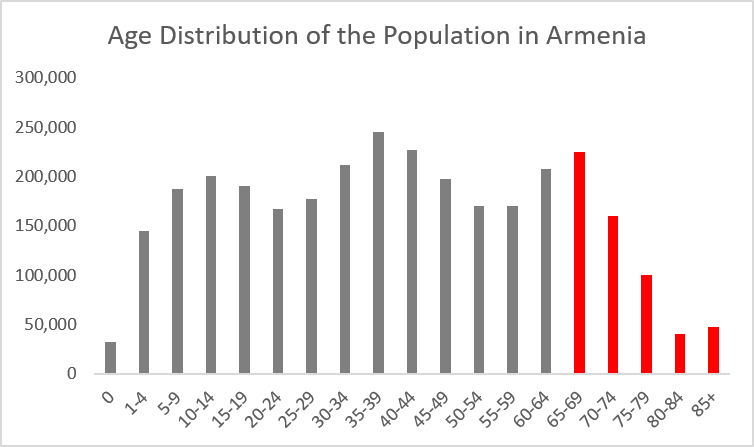
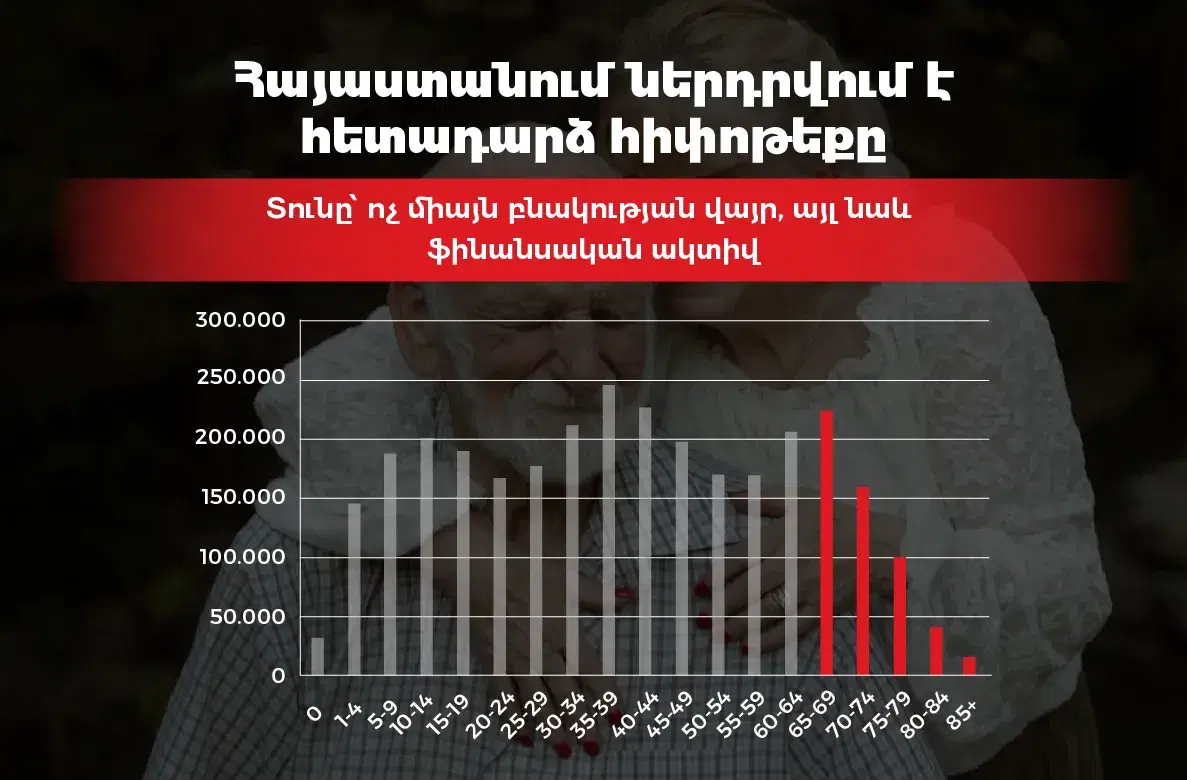
According to data on the age distribution of the population, around 570,000 people aged over 65 live in Armenia, of whom around 505,000 are identified as pensioners. At the same time, the average monthly pension is 49,450 AMD. These figures show that a reverse mortgage may have not only market significance, but also clear social importance. It can create an additional financial opportunity for people who own real estate, but whose monthly income is often limited not only in terms of covering everyday expenses, but also in organizing a more prosperous life. The purpose of a reverse mortgage is not only to cover household or healthcare expenses. This tool can contribute to improving the quality of life of elderly people by giving them the opportunity to manage their own financial resources more freely.
At the same time, it concerns highly sensitive issues related to elderly people’s primary residence, the family’s property interests, and future inheritance relations. Therefore, in the case of its application, clear protective mechanisms, mandatory consultation, property valuation, transparent presentation of terms, accountability, and supervision will be especially important.
Reverse mortgage or similar tools for releasing property capital are not a new phenomenon in international practice. They are applied in different formats in a number of developed countries as a mechanism that provides elderly property owners with an additional financial opportunity. For example, in the United States, the Home Equity Conversion Mortgage program operates for homeowners aged 62 and above and allows part of the home equity to be converted into usable financial resources without the need to immediately give up the property. International experience shows that the success of such tools depends not only on the adoption of the law, but also on the quality of its implementation, financial literacy, supervision, the preparedness of the banking system, and public trust. For this reason, it is important for Armenia that the introduction of the tool be accompanied not only by legal regulation, but also by public explanatory work and clear protective mechanisms.
At the same time, it should be noted that the reverse mortgage is simply a tool, and its use depends on the will of pensioners.
Data source: Statistical Committee of the Republic of Armenia.
Source of the international example: U.S. HUD/FHA Home Equity Conversion Mortgage Program.
Developed and complemented by RED Invest Group.


