 2026-08-05
In the first half of 2026, the primary real estate market of the Republic of Armenia demonstrated high activity, recording one of the strongest half‑year results in recent years. The market not only maintained the growth pace established in previous months, but activity also became more balanced both in Yerevan and in several regions. A number of factors simultaneously influenced the formation of this activity. These include the increase in demand in suburban regions, where the income tax refund program continues to operate until the end of 2026; the preservation of high activity in Yerevan’s primary market despite the termination of the program in the capital; and the development of new investment directions, the most notable being Dilijan, where the state support program is valid until 2029.
At the same time, the market’s high activity was supported by more flexible financing conditions offered by developers, particularly installment payment programs, as well as the joint efforts of market participants in presenting new projects and stimulating demand.
Below is the analysis of the main indicators of the primary market and the trends formed during the first half of 2026.
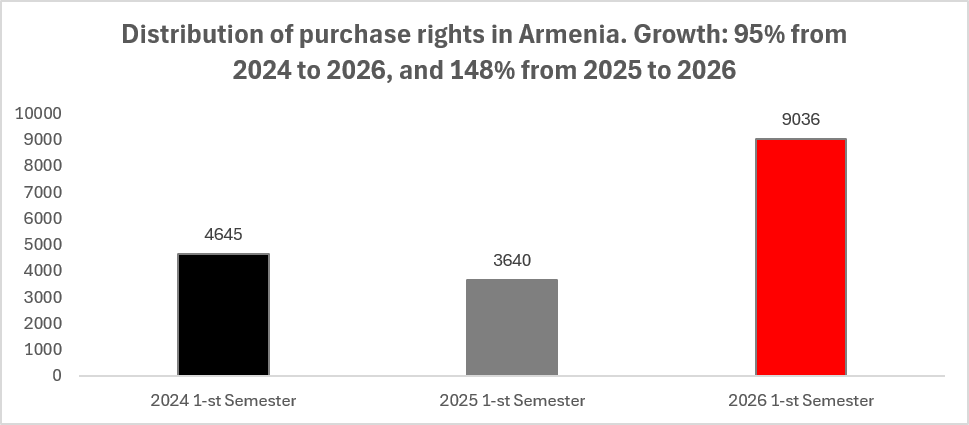
In the first half of 2026, 9,036 purchase rights were registered in the primary real estate market of the Republic of Armenia, which represents a 148% increase compared to the same period of the previous year. Notably, the market also exceeded the result of the first half of 2024, recording a 94.5% increase. The comparison with two different bases is important for assessing the real dynamics of the market. The year 2025 can be described as a stage of stabilization and the formation of a new balance, when demand gradually adapted to new regulations and market conditions. It was precisely on this stabilized foundation that in 2026 the market entered a phase of active growth, significantly surpassing not only the indicators of 2025 but also those of 2024.
The results of the first half-year indicate that the market’s growth is not due to one-off factors. It was formed under conditions of gradually strengthening demand, expanding supply, and a new market balance, which made the first half of 2026 one of the most active periods in recent years.
The overall growth of the primary real estate market does not yet fully reveal where demand has been formed and how its territorial structure has changed. For this purpose, it is important to separately examine the indicators of Yerevan and the regions, since in recent years the driving factors behind the development of these two markets have differed significantly. Yerevan continues to remain the main center of the primary market due to its large supply, population density, and investment activity. At the same time, in the regions new prerequisites for growth have emerged in recent years, driven by state support programs, the expansion of new residential projects, and the gradual increase of investment interest.
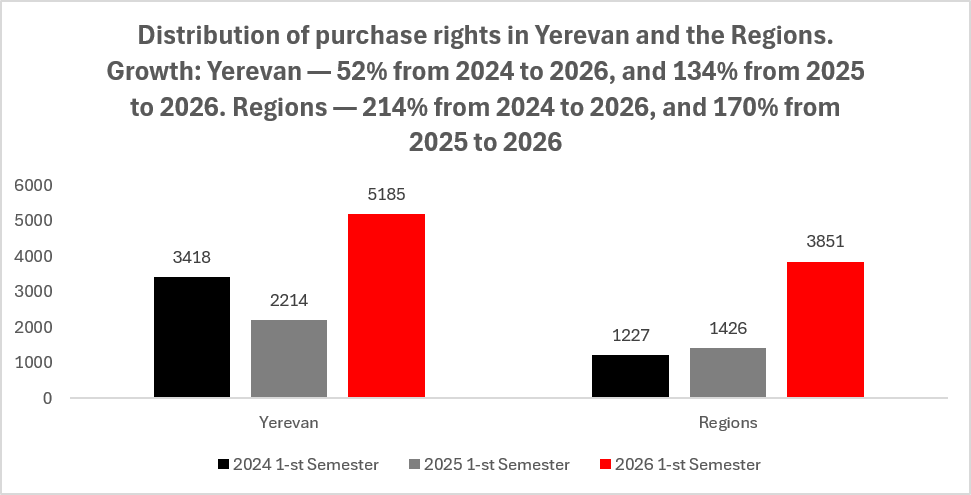
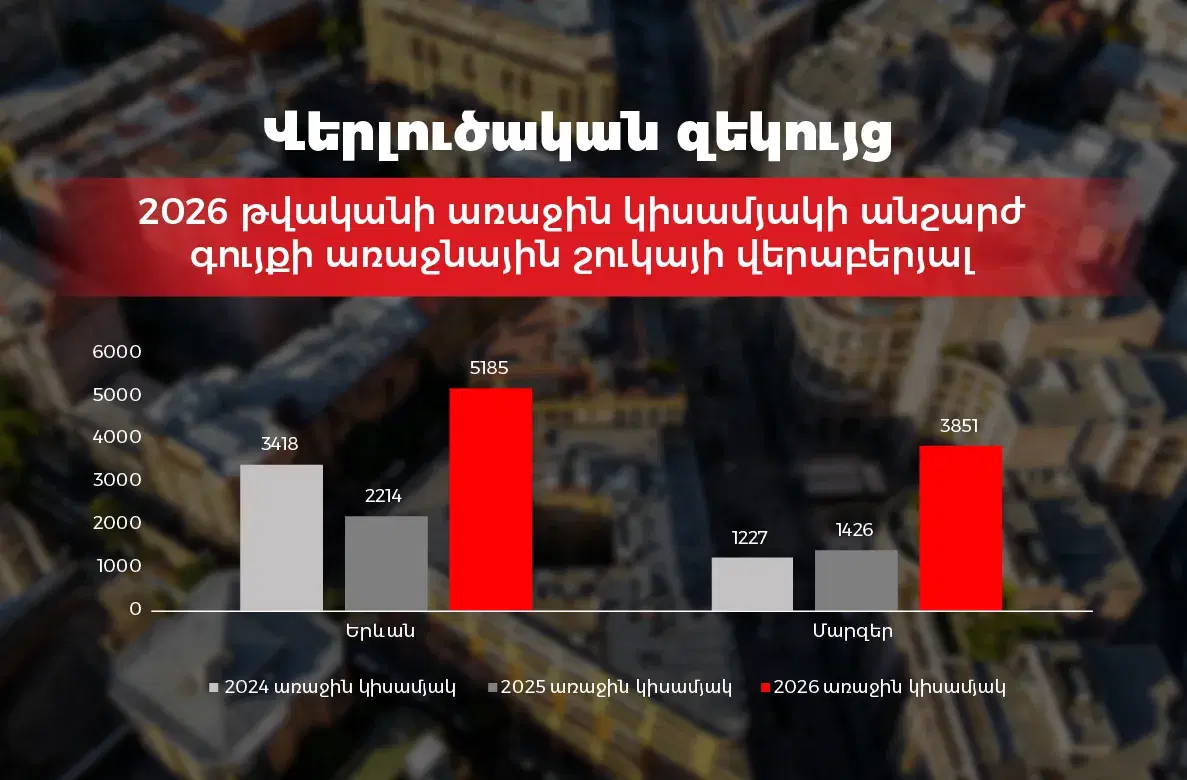
In the first half of 2026, Yerevan maintained its leading position in the primary real estate market, registering 5,185 purchase rights. This represents a 134% increase compared to the same period in 2025 and a 52% increase compared to 2024. This result is particularly important, as it was recorded after the termination of the income tax refund program, indicating that the capital’s primary market continues to sustain high demand based on its internal market factors. At the same time, faster growth was recorded in the regions. In the first half of 2026, 3,851 purchase rights were registered in the regions, which means a 170% increase compared to 2025 and a 214% increase compared to 2024. This dynamic shows that market activity is gradually moving beyond Yerevan and spreading to other settlements, where demand is supported both by ongoing state support programs and by the development of new residential projects and investment directions.
Overall, the chart shows that in the first half of 2026, market growth was formed in two directions: Yerevan maintained its high activity, while the regions became the main accelerating factor of growth. This indicates a more balanced territorial development of the primary market and an expansion of demand.
Under the conditions of maintaining the overall activity of Yerevan’s primary market, it is interesting to examine how demand has been distributed among the capital’s individual administrative districts. Analysis at the community level makes it possible to identify the areas where new construction volumes, investment interest, and buyer demand have shaped the highest activity.
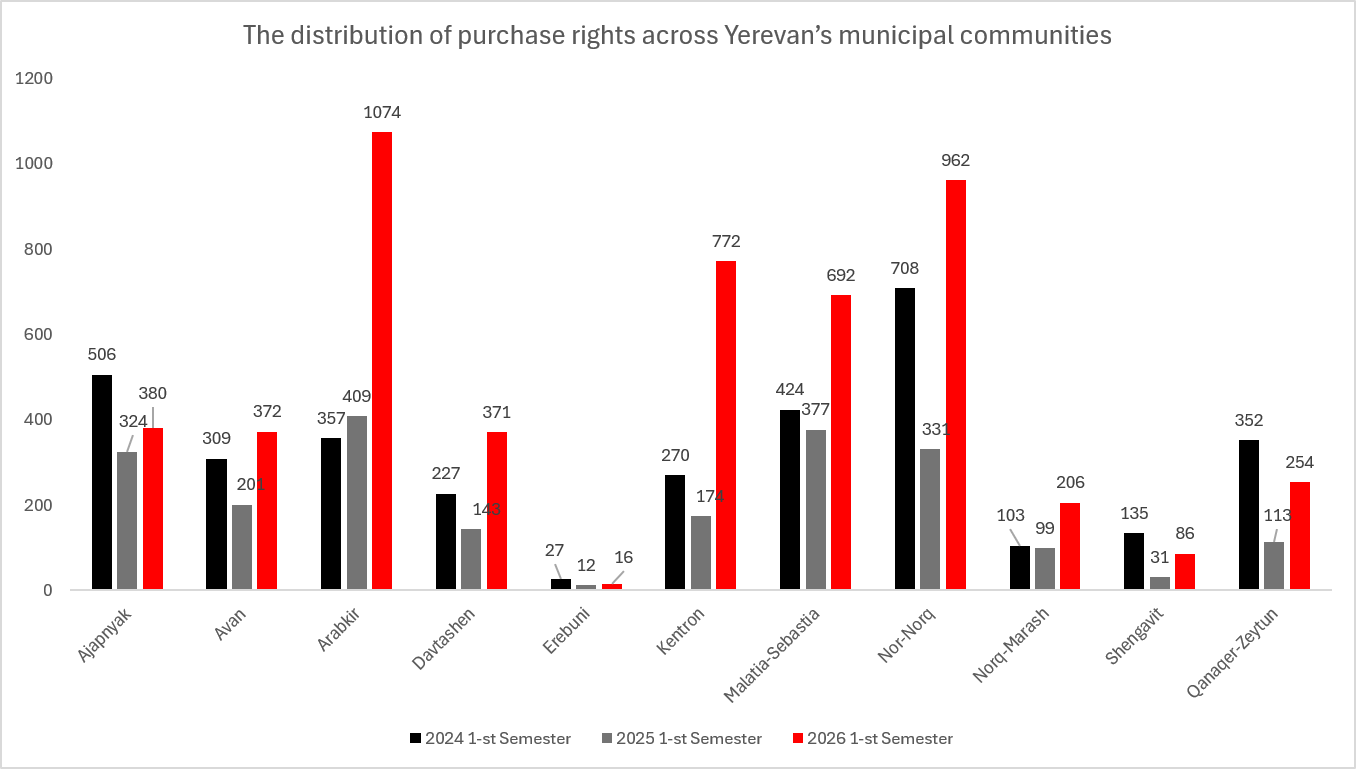
In the first half of 2026, the highest activity continued to be maintained in Arabkir, Nor Nork, and Kentron, which traditionally serve as the main centers of Yerevan’s primary market due to the large volume of new residential projects and stable demand. At the same time, Norq-Marash stands out in particular: although in absolute terms it still lags behind the leading communities in the number of transactions, compared to the first half of 2024 it recorded growth of around 100%. This indicates that the community is gradually emerging as a new growth direction for the primary market.
If in Yerevan the main issue is the distribution of demand among administrative districts, then in the regions it is important to understand which territories are driving the growth of the primary market. Regional-level analysis makes it possible to assess where new construction is concentrated and in which directions the market is expanding.
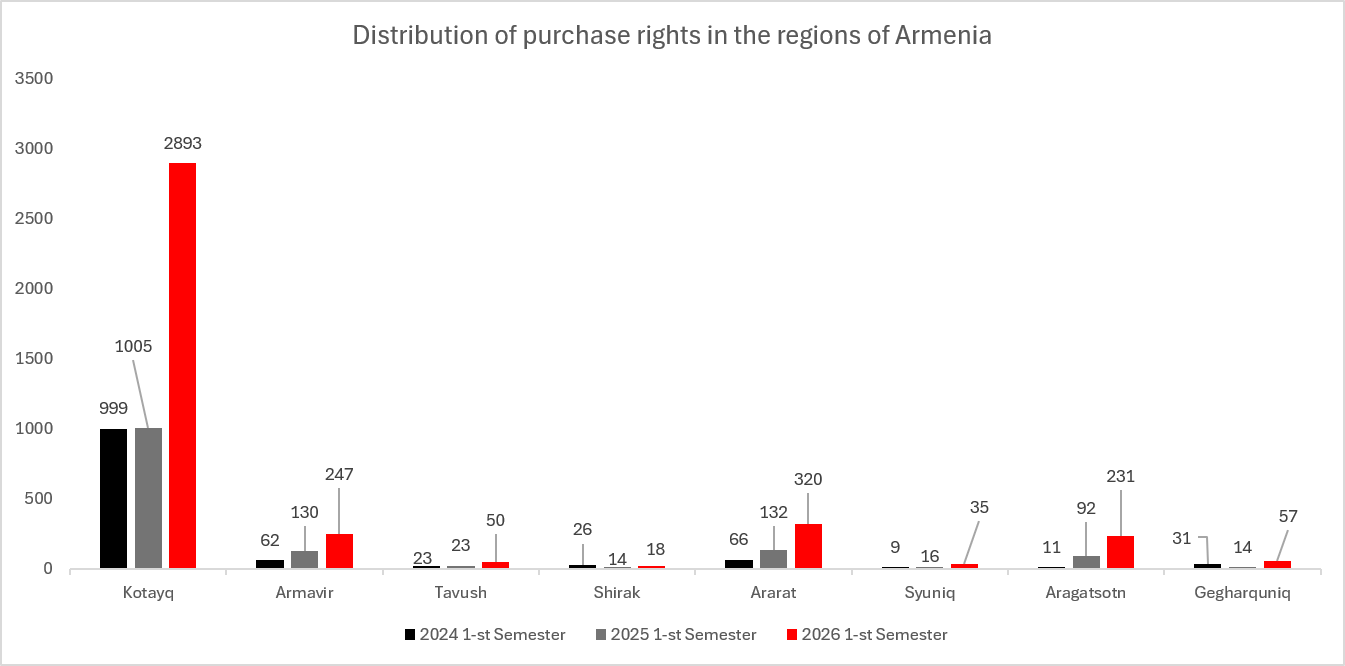
In the first half of 2026, most of the activity in the regions continued to be concentrated in Kotayk province, where 2,893 purchase rights were registered. The province’s leading position is due not only to its geographical proximity to Yerevan, but also to the fact that in suburban settlements the state income tax refund program continues to operate, with its validity ending at the close of 2026.
At the same time, the chart shows that non-suburban regions are gradually becoming more active. Tavush, Shirak, Syunik, and Gegharkunik, although still having relatively small transaction volumes, are already shaping new directions for market development. The growth of activity in these regions is not driven by proximity to the capital, but by new residential projects emerging in these territories, increasing investment interest, and the gradual maturation of local markets.
The results of the first half of 2026 indicate that the primary real estate market of the Republic of Armenia is entering a new stage of development. The recorded growth is not driven by a single factor or a single region; it has been shaped both by Yerevan’s stable activity and by the expansion of demand in the regions. At the same time, the territorial structure of the market continues to change. While activity in suburban provinces is mainly determined by geographical location and the influence of state support programs, in several other regions new directions of development are already emerging, based on the specific investment potential of these territories and new residential projects.
These trends show that Armenia’s primary real estate market is gradually becoming more multipolar and balanced. Such changes create the foundation for the market’s further sustainable development and allow us to expect that in the coming years, growth in activity will be shaped not only in the capital but also across different regions of Armenia.
Data source: Cadastre.am
Processed and supplemented by RED Invest Group


