 2026-08-14
Over the past decade, Dilijan has gradually become one of Armenia’s fastest-growing regional cities. While it was previously known primarily as a resort and tourist destination, today the city is shaping a new development model that combines tourism, education, residential development, and investment activity. Dilijan’s development has been supported by both public and private investment, as well as international educational, cultural, and community initiatives. The city’s natural environment, favorable climate, relatively developed infrastructure, and accessible distance from Yerevan have significantly increased its attractiveness in recent years, not only for tourists but also for homebuyers and investors.
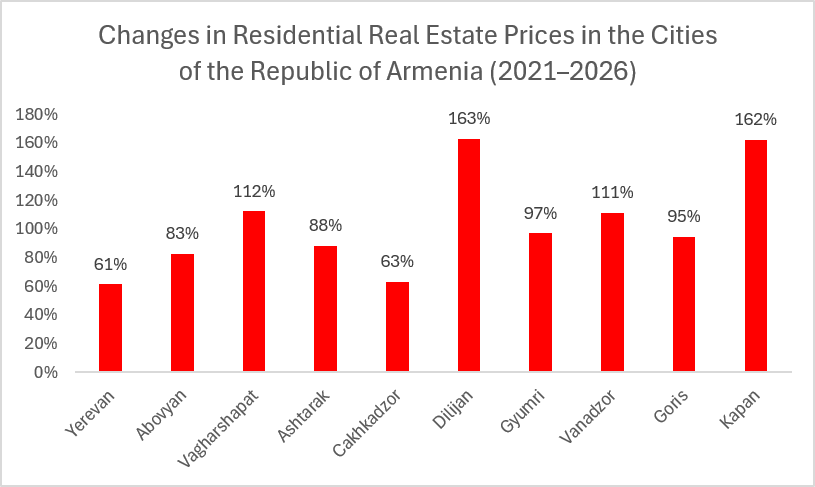
Between 2021 and 2026, residential real estate prices in Dilijan increased by 163%, recording the highest growth rate among the cities presented. This dynamic reflects the strong demand and growing investment interest in the city’s real estate market in recent years.
In 2025–2026, Dilijan’s primary real estate market maintained stable activity while simultaneously demonstrating growth trends. Although the market lags behind the capital in terms of transaction volumes, recent years have seen consistent growth in demand and development activity, indicating the emergence of a new stage of development. From the perspective of the market’s further development, changes in the state housing policy are also of significant importance. After the end of 2026, the income tax refund program will cease to apply in Yerevan and the regions surrounding Yerevan, as a result of which the impact of this state incentive will be primarily concentrated in Armenia’s regions.
In this context, Dilijan stands out as one of the more promising destinations. The city’s tourism potential, the attractiveness of its residential environment, the increasing number of new projects, and growing investment interest provide grounds to suggest that in the coming years it could become one of the regional real estate markets most significantly affected by state support programs. At the same time, recent years have also seen growing interest from developers. A number of new residential and multifunctional projects have been launched in Dilijan, indicating that private capital views the city not as a short-term opportunity, but as a destination for long-term development.
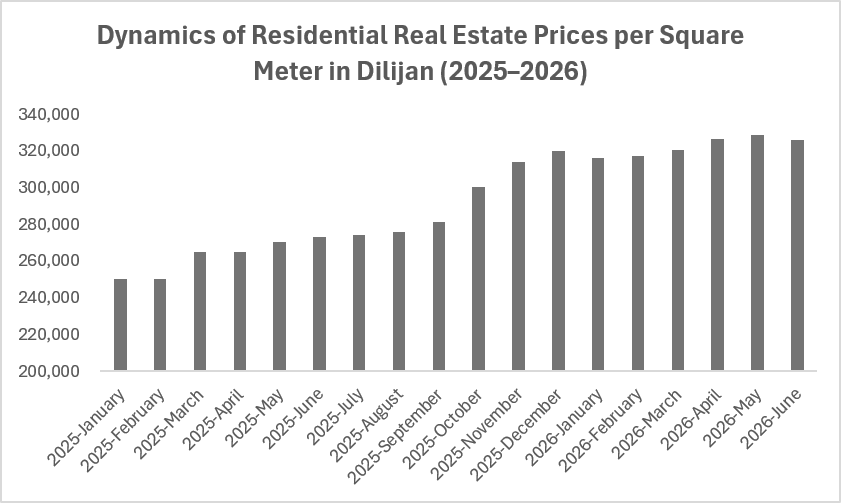
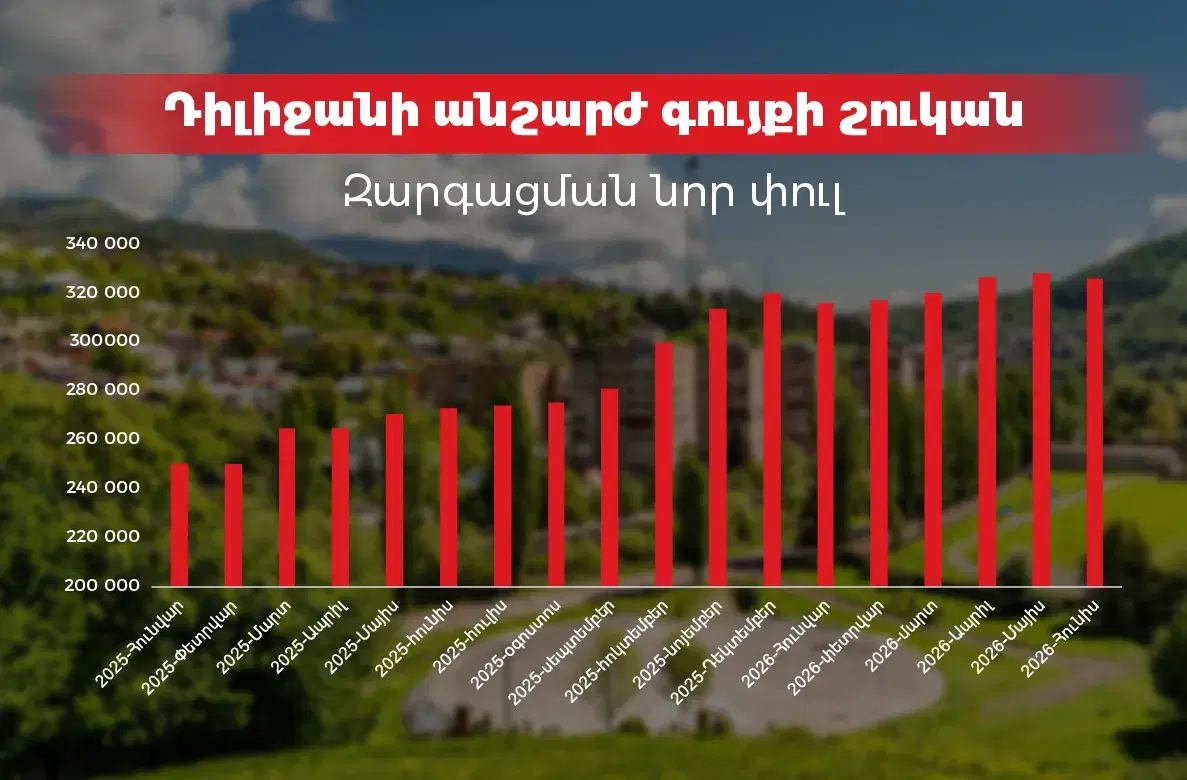
In 2025–2026, the residential real estate market in Dilijan recorded steady price growth. While the average price per square meter of residential real estate was around AMD 250,000 in January 2025, it reached AMD 328,500 in May 2026. As a result, over the past year and a half, the average price per square meter of residential real estate increased by approximately 31.4%.
This price dynamic indicates that increased market activity is also translating into a steady rise in property values. Notably, the growth has been gradual, without significant price declines, which is characteristic of developing markets with stable demand. The increase in prices is driven not only by expanding demand but also by qualitative changes in supply. New projects entering the market in recent years are raising the quality of residential developments, the level of infrastructure, and service standards, which in turn is also affecting the market’s average price level.
In recent years, a trend has emerged in Dilijan’s real estate market that differs from the developments observed in previous years. While development was previously focused mainly on small-scale residential or hotel projects, larger and more multifunctional projects are now entering the market, with architectural, design, and investment teams with international experience involved in their development and implementation. This indicates that interest in the city is gradually expanding beyond the boundaries of the local market.
One example of this trend is the multifunctional complex being developed by Green Rock Management Group, covering an area of approximately 60,000 sq. m and comprising a residential complex, a hotel, as well as educational and public infrastructure. The Takhta residential complex, which forms part of the project, is being developed within the framework of international architectural cooperation. Urban development programs are also continuing in Dilijan through initiatives implemented by the IDeA Foundation and the Dilijan Development Foundation. These include programs aimed at improving the urban environment, developing public spaces and tourism infrastructure, and preserving cultural heritage, contributing to the city’s development and creating new opportunities for private investment.
Overall, the projects being implemented in Dilijan in recent years demonstrate that the city’s real estate market is gradually being supplemented not only by individual residential or hotel properties, but also by multifunctional projects that combine residential, hospitality, educational, commercial, and public-use components. This trend reflects changes in the structure of supply and the gradual development of the market.
Developments in Dilijan’s real estate market in recent years indicate that a more structured and diversified market environment is taking shape in the city. The market is gradually being supplemented by projects of various formats, supply is expanding, and development approaches are becoming increasingly multifunctional. At the same time, the market’s further development will depend on the pace at which investment programs continue to be implemented, as well as on how effectively the city’s transport, engineering, and social infrastructure develops. In the long term, these factors will shape Dilijan’s competitiveness within Armenia’s regional real estate market.
Under these conditions, Dilijan remains one of Armenia’s regional cities whose real estate market is in an active stage of development and merits continued monitoring by both market participants and those studying the investment environment.
Source: Official data of the Cadastre Committee of the Republic of Armenia (cadastre.am)
The analysis was prepared and supplemented by RED Invest Group.


