 2025-10-28
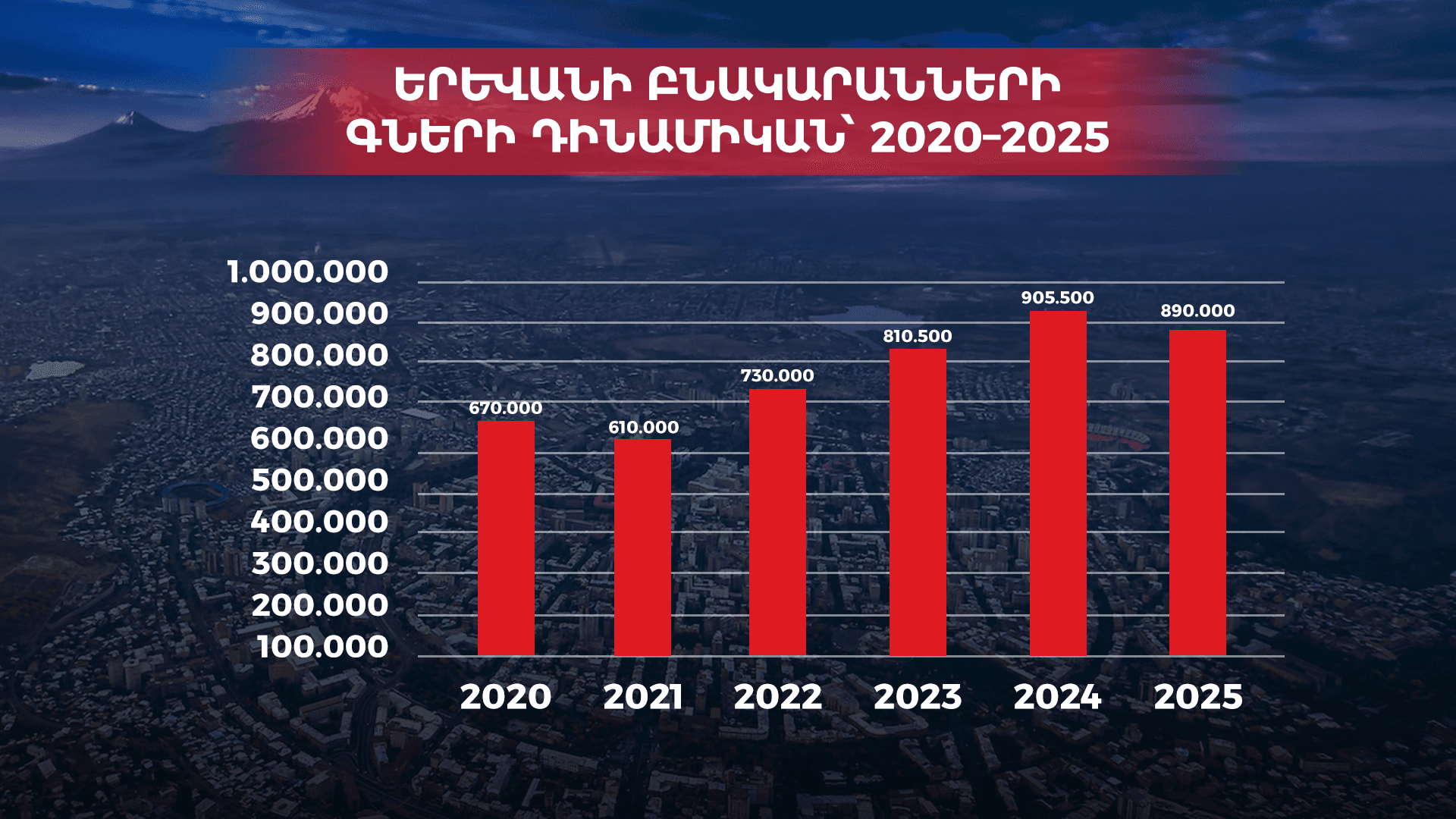
Between 2020 and 2025, apartment prices in Yerevan were shaped by economic, social, and political factors.
The market responded to both internal and external stimuli, creating a multilayered pricing landscape.
This period was marked by the impact of the pandemic, the influx of migrants, and government policy.
There are notable differences between cadastral and agency data, requiring integrated analysis.
● Impact of COVID-19 and the Artsakh conflict on the market in 2020
In 2020, the real estate market faced challenges related to the COVID-19 pandemic and the conflict in Artsakh.
The total number of real estate transactions registered by the Cadastre Committee was 158,600, including not only sales but also leases, inheritance, mortgages, and all other types of transactions — nearly 15% lower than the previous year.
Sales transactions dropped by 10.4% compared to 2019, totaling 46,159. In Yerevan, sales declined by 22%.
Despite the drop in transaction volume, nominal prices in Yerevan (in AMD) continued to rise — by an average of 7.5% per square meter.
However, due to the dram’s depreciation against the US dollar (8.9% by year-end), real prices actually decreased slightly.
In Q4 2020, the war caused the steepest drop in sales — 30.5%.
Tourism came to a halt, negatively affecting the short-term rental market.
● Drivers of economic recovery and growth
After the 2020 downturn, Armenia’s economy entered a deep recovery phase.
GDP growth slowed to 5.9% in 2024 (from 12.6% in 2022 and 8.3% in 2023), but remained high, with further slowdown projected — 5.0% in 2025 and 4.5% in 2026.
This growth, supported by services, industry, and construction, directly affects real estate demand.
Key drivers of real estate market development include:
● Growth in foreign investment and the tech sector — boosting demand for residential and commercial real estate, especially in Yerevan.
● Migrant influx — Since the start of the Ukraine conflict in 2022, around 50,000–65,000 migrants from Russia, Ukraine, and Belarus have settled in Armenia, equivalent to 2.2% of the population. This influx significantly increased demand, especially for rental housing, leading to market overheating and price growth.
● Government initiatives and tax incentives — Favorable tax incentives aimed at improving housing affordability, most notably the income tax refund on mortgage interest (a key driver of the primary market, available only in the regions starting January 1, 2025).
● Growth in the construction sector — Construction grew by 13.5% in 2024, and according to forecasts by the Asian Development Bank, is expected to grow by 14.0% in 2025 and 14.9% in 2026, driven by public and private investment.
According to the Cadastre Committee:
In 2020, Yerevan recorded 13,899 sales transactions.
Arabkir had the highest number of transactions, with an average apartment price of 452,000 AMD ($1160) per sqm.
Kentron ranked second with 1,258 transactions and an average price of 644,800 AMD ($1670) per sqm.
Nubarashen had the fewest transactions (37) and the lowest average price — 183,100 AMD per sqm.
In 2021, the number of sales transactions in Yerevan increased by 26.6%, while prices remained largely unchanged — down 0.02% compared to 2020.
In 2022, Yerevan recorded 64,547 total transactions, of which 17,734 were sales.
Kentron had the highest share of sales — 18.3%.
The average market price in Yerevan was 385,600 AMD ($992) per sqm.
In 2023, total transactions in Armenia reached 219,628, a decrease compared to 2022.
Sales transactions declined by 5.4% nationwide and by 23.8% in Yerevan.
However, transactions increased by 8.3% in the regions and by 1.4% in rural areas.
According to the Cadastre Committee, average apartment prices in Yerevan rose by 10.3%.
Kentron led with 837,700 AMD ($2070) per sqm, followed by Arabkir (587,850 AMD / $1453) and Davtashen (428,300 AMD / $1058).
Kentron saw the highest annual price growth (13.5%), Davtashen the lowest (1.9%).
In 2024, Armenia recorded 57,796 sales transactions, with 30.9% in Yerevan.
Sales transactions in Yerevan increased by 32.1% compared to 2023.
Average apartment prices in Yerevan rose by 8.8%, reaching 462,850 AMD per sqm.
Kentron retained the highest prices (905,600 AMD / sqm, +8.1%), followed by Arabkir (637,300 AMD / sqm, +8.4%) and Davtashen (476,700 AMD / sqm, +11.3%).
Nubarashen remained the lowest-priced district (229,900 AMD / sqm, +7.3%).
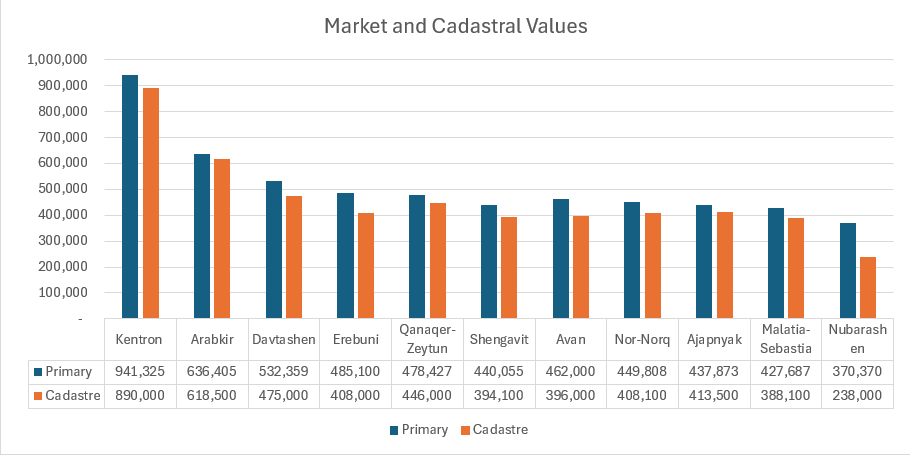
When analyzing Armenia’s real estate market — especially in Yerevan — it’s important to consider the differences between official data published by the Cadastre and assessments provided by independent experts and real estate agencies.
These discrepancies stem from differences in data collection and interpretation methodologies.
According to a study conducted by Red Invest Group, when compared with cadastral data, the difference between market and cadastral prices ranges from 3% to 36% depending on the district.
The main reason for this gap is sellers’ tendency to overestimate their property value and apply subjective pricing.
Opinions on Yerevan’s real estate market in 2025 vary. Some believe that due to saturation in 2024, a force majeure situation may arise in 2025.
However, Red Invest Group experts suggest that while a decline in transaction volume is possible, historical data shows that even in force majeure conditions, transaction volumes may drop, but prices tend to remain stable or even increase.
Therefore, no sharp price increase or decrease is expected by the end of 2025.
Barring external shocks, Armenia’s real estate market — particularly in Yerevan — is expected to continue its stable growth trajectory.


