 2025-10-30
Preface
If we summarize Armenia's real estate market in the last years briefly, it would be: before and after the tax refund—like life before and after the revolution. The 2014 law on income tax refunds had a revolutionary positive effect on the Armenian real estate market, especially in Yerevan, the primary beneficiary of the law. It was expected that from January 1, 2025, when the law ceased in Yerevan, a revolutionary negative aftermath would follow—“the bubble bursting,” market collapse, a major crisis. Yet, contrary to all pessimistic forecasts, that did not happen. Reality in the first half of 2025 showed all these expectations were, to put it mildly, unrealistic and greatly exaggerated. This article aims to analyze expectations, document facts, and identify trends.
Expectations
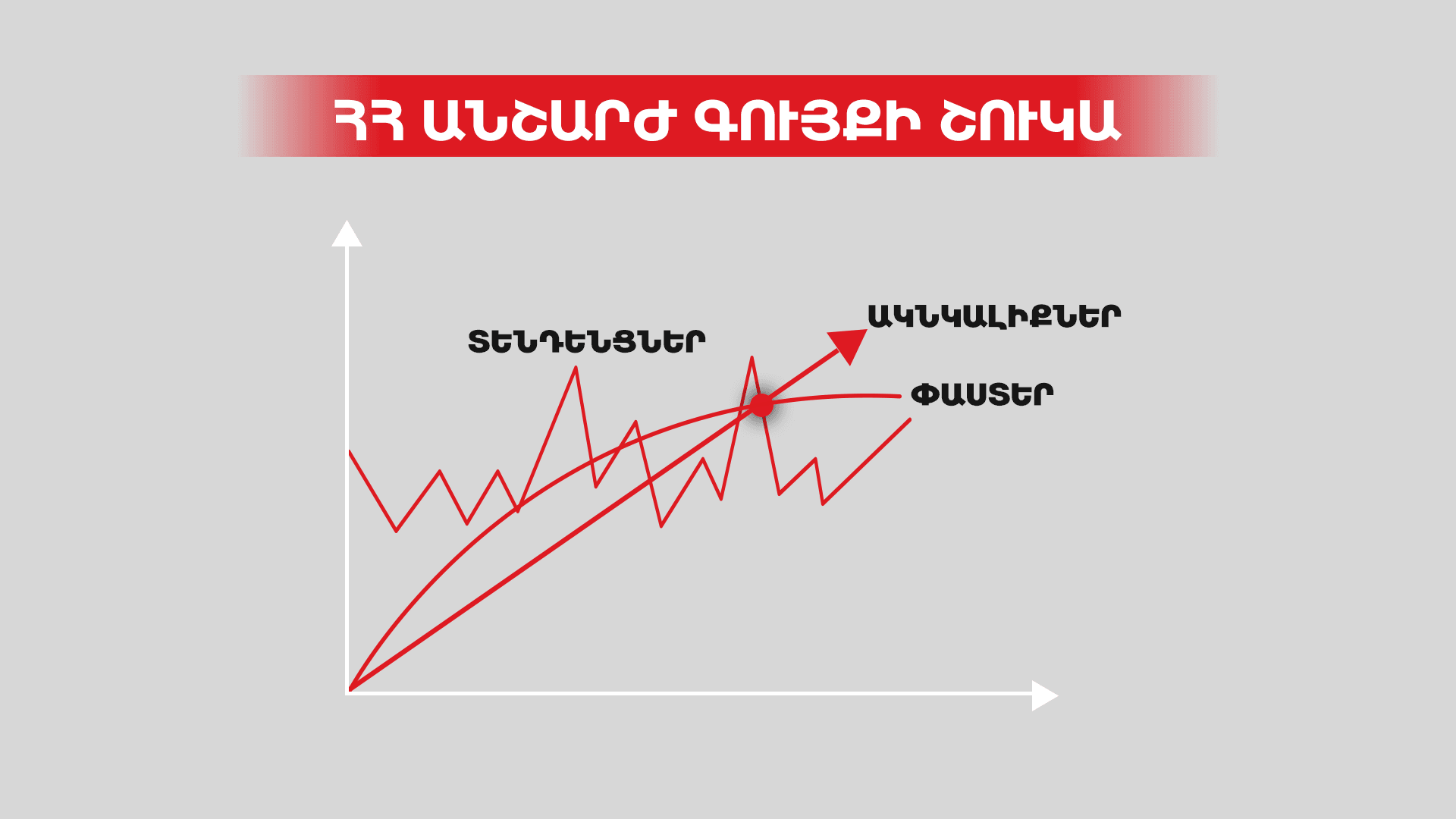
Expectations among developers and buyers started forming as early as 2021, when the government announced a plan to phase out the income tax refund in Yerevan by January 1, 2025. From that moment onward, dispositions, forecasts, and expectations emerged. With a known deadline, market participants formulated short-term strategic plans. Consequently, 2021–2024 saw a surge in construction projects in Yerevan, driven by developers aiming to meet deadlines, finalize permits and documentation, organize quick construction, and sell critical volumes of property. It was clear that in 2024, just before the law’s termination, market activity would peak. That’s exactly what happened: an unprecedented market boom. Developers “played with open cards,” offering every possible discount and selling condition; buyers were highly active, speeding up decisions to notarize purchases before December 2024, to access the benefits before they ended. In 2024, the market “boiled” against this backdrop of high expectations, which were confirmed numerically.
By the Numbers
The Cadastre Committee, which previously provided data on actual sales, first published figures on purchase rights for new apartments in buildings under construction — in short, data on transferring purchase rights. In H1 2024, Yerevan recorded 3,418 such transfers; in H2, there were 9,418—nearly threefold. Across Armenia, total transfers reached 15,730: 4,645 in H1 and 11,085 in H2. Roughly 80% of the market is in Yerevan. Unfortunately, we can’t compare with 2023, since prior to 2024, data covered property ownership transfers, not purchase rights. But even just 2024 figures show the positive expectations fostered a matching environment and activity, leading to explosive market growth.
| Republic | 2024 1st semester | 2024 2nd semester |
| Yerevan | 3 418 | 9 418 |
| Kotayk | 999 | 1 362 |
| Armavir | 62 | 124 |
| Tavush | 23 | 28 |
| Shirak | 26 | 21 |
| Ararat | 66 | 72 |
| Syuniq | 9 | 16 |
| Aragatsotm | 11 | 30 |
| Gegharquniq | 31 | 14 |
| Vayots Dzor | - | - |
| Lori | - | - |
| Total | 4 645 | 11 085 |
Negative Expectations
Alongside the 2024 boom, negative forecasts became prevalent. It was clear to everyone that after the end of the tax refund in Yerevan, there would be a substantial retreat. Demand was assumed to be exhausted. Even those who planned to enter the market in 2025 accelerated their plans to benefit from the tax refund in 2024. For non-specialists, it was obvious that in 2025 — at least in Q1 or H1 — the market would experience a slowdown, fewer transactions, and significant price drops. These projections both worried developers and excited prospective buyers hoping for cheaper options. However...
Charts
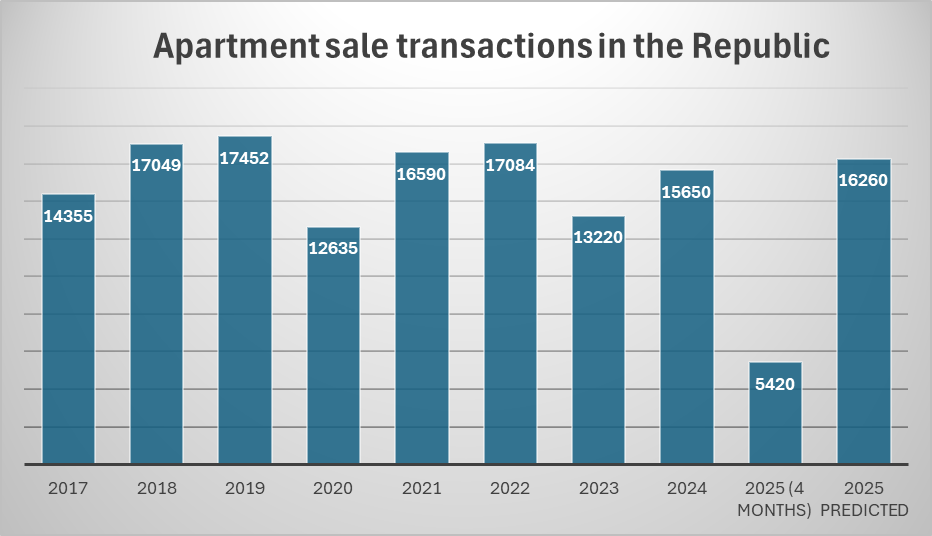
Though 2025 is only halfway through, it's already clear: negative expectations were overly exaggerated and largely unfounded. There is no widespread price collapse. Minor price adjustments appear only in certain projects facing challenges and risks—those that didn't achieve critical sales in 2024 and are now reducing prices to attract buyers. Overall, the market continues calmly. This is especially true for developers who had effectively insulated themselves with strong 2024 sales and thus don’t rely on the current slow phase. Thanks to triple transaction volume in H2 2024, most developers have secured cash flow through H1 2025, and the most flexible and foresighted even through the rest of the year.
Thus, we have — on one hand — developers enjoying stable confidence and nearly zero cash-flow issues, and on the other, buyers awaiting price drops that aren’t materializing.
Facts vs Negative Expectations
Indeed, transactions in Yerevan fell in Q1 2025, but since most developers aren't financially strained and don’t depend on monthly sales for cash flow to continue construction, there’s no reason to lower prices. If a developer sold, say, 120 apartments in one month, well above the planned 10/month, they’ve accumulated enough capital to proceed with construction without discounting. That’s why prices remain stable—or even rise—in some Yerevan projects.
Projecting this across the market: the nearly 3× increase from H1 to H2 2024 (≈3,418 → ≈9,418) represents buyers "pre-purchasing" from what would have been 2025 demand.
Market Realities & Trends
Associated Factors
Key Year Highlights
Conclusion
Given the above expectations, facts, and trends: 2025’s real estate market in Armenia—especially in Yerevan—is categorically different from 2024. Comparing them is incorrect. 2025 must be seen as a separate phase with dynamic monthly metrics. If the market rises month-over-month — and it does — then a new stage of market development and activity is underway. Therefore, after the turbo‑charged 2024, neither—“Armageddon” nor collapse occurred. The market is stable, trends strongly positive. Considering the facts, dynamics, restraining & encouraging measures, institutional steps by industry players, and the natural, market‑driven behavior of buyers, we can conclude: Armenia’s real estate market is now entering (if not already within) a stable growth and qualitatively new stage, and a further upswing will begin by the end of 2025.


