 2025-12-11
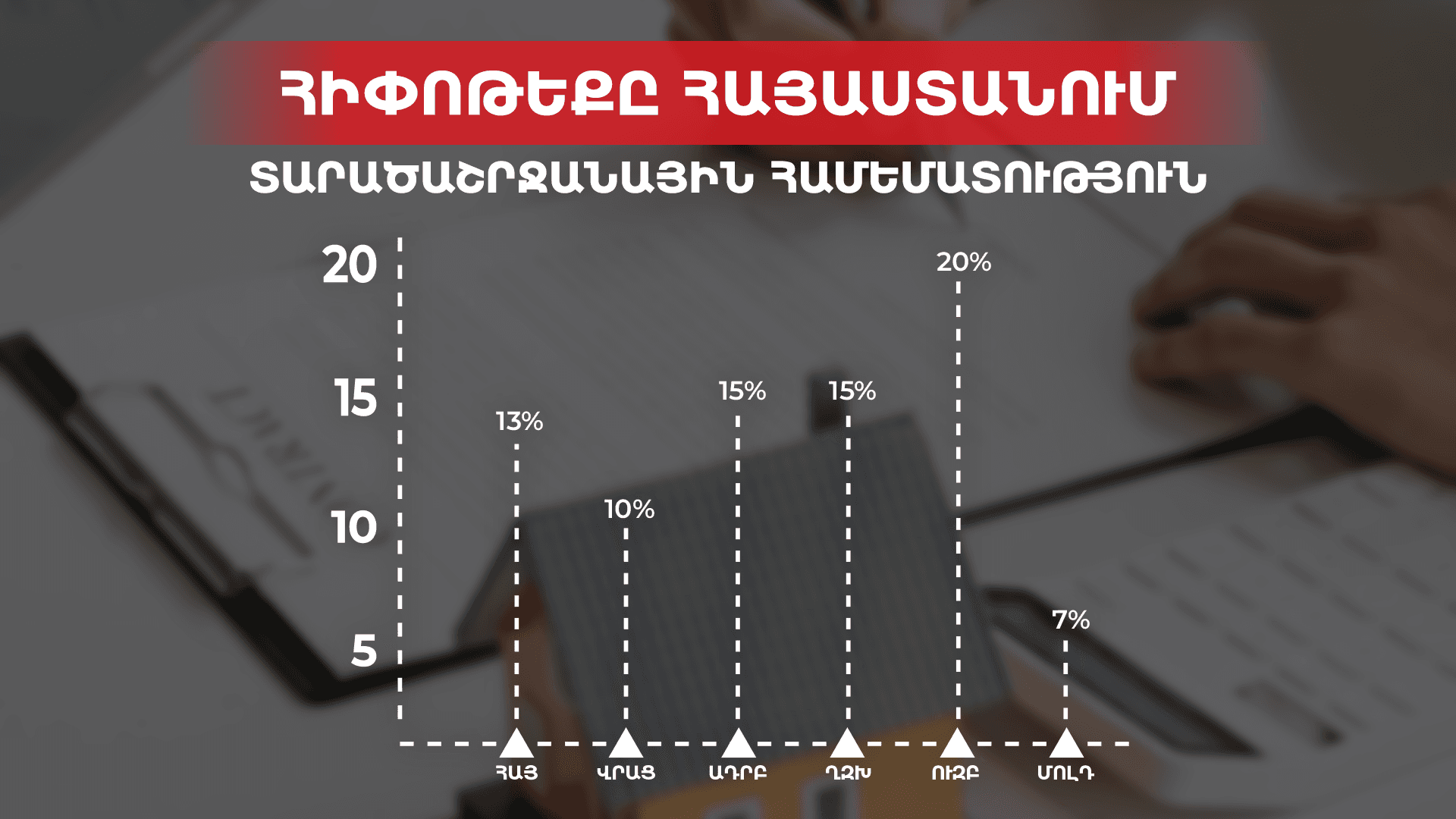
The mortgage is a key financial instrument in the housing and real estate market, simultaneously providing households with the opportunity to acquire housing and banks with minimal credit risk. As a loan product, it is distinguished by its long-term nature, collateralization, and social significance.
In Armenia, the widespread adoption of mortgages was driven by the introduction of the income tax refund law, which allowed working citizens to reclaim their paid income tax and direct it toward repaying mortgage interest. This mechanism significantly reduced the monthly burden and made homeownership accessible to middle-income families. Thousands of people, without substantial financial preparation, were able to enter the housing market, leading to a sharp increase in demand and a construction boom. Mortgages have both advantages and risks. Advantages include access to large sums, long-term repayment with relatively small monthly installments, and comparatively low interest rates. Risks are associated with the potential loss of property in case of non-payment, as well as limited financial flexibility due to long-term obligations.
Although the income tax refund program was discontinued for new contracts, the thousands of homes already purchased demonstrate that this policy had a major social impact. In Armenia, the mortgage is not only a financial instrument but also an important component of social policy, enabling thousands to realize their housing dream while stimulating the development of the construction and financial markets.
Evaluating the mortgage market requires considering not only the offered conditions and consumer accessibility but also the broader effects on the economy and social environment. In this context, it is important to examine Armenia’s experience comparatively, alongside Georgia and Azerbaijan, as well as countries with similar economic structures, living standards, and post-Soviet backgrounds.
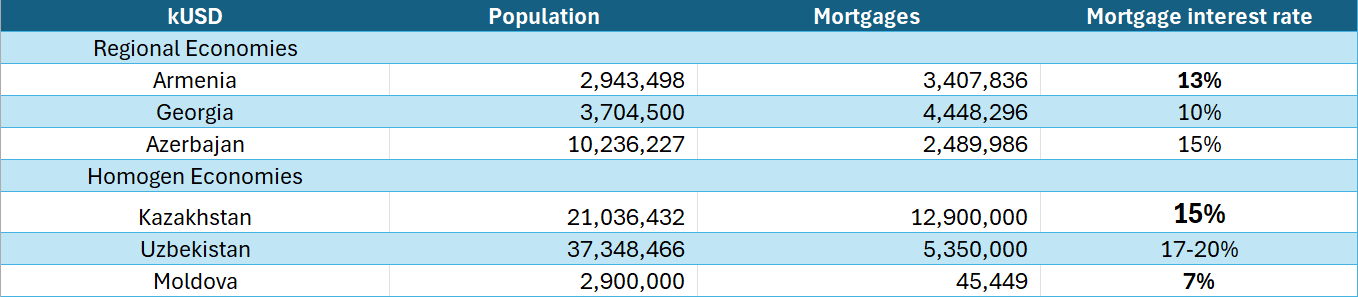
This selection reveals both regional similarities and differences, as well as common patterns typical of small markets with limited financial resources and housing demand stimulated by social policy.
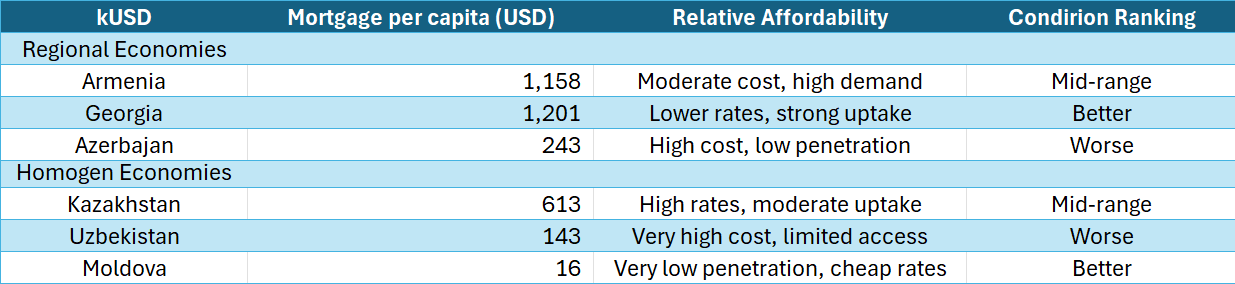
The analysis positions Armenia as the baseline. Georgia shows certain advantages over Armenia, with lower interest rates and higher per capita involvement, indicating a more accessible and active market. Azerbaijan lags behind Armenia due to high interest rates and very low per capita participation, limiting accessibility. Kazakhstan’s market is larger, but due to its population size, per capita indicators are lower, and higher interest rates make it less affordable compared to Armenia. Uzbekistan has the weakest position, with very high interest rates and extremely low per capita involvement, leaving it far behind Armenia. Moldova offers lower interest rates but has a very small market size and penetration, also trailing Armenia. Overall, Armenia has a stable, relatively accessible, and highly engaged mortgage market in the region. The analysis is based on data as of December 31, 2024.
Let us calculate comparatively, based on the minimum required housing area of 25 m² per person. Using the average price per square meter in the capitals of the selected countries, we estimate what share of GDP per capita is consumed annually by mortgage payments for such housing.

Armenia’s housing market can be described as moderately burdensome. The annual mortgage load amounts to about 42% of GDP per capita, meaning that homeownership is difficult but possible for middle-income individuals. In Georgia, the figure is nearly the same—40%, making the situation comparable. In Azerbaijan, the burden is significantly higher—64%, making the market heavier and less accessible. In Kazakhstan, the figure is lower—36%, making homeownership relatively easier. In Uzbekistan, the situation is extreme—172%, meaning that homeownership is practically impossible for average-income individuals. In Moldova, the figure is 59%, closer to Azerbaijan’s situation.
Thus, Armenia can be considered a balanced market: better positioned than Azerbaijan and Moldova, but more burdensome than Georgia and Kazakhstan. This shows that Armenia’s housing market has a certain stability, but improving affordability requires income growth and lower interest rates.
The data confirm that mortgages in Armenia are not only financial instruments but also important components of social policy, already transforming the lives of thousands of families and stimulating construction and financial market development. However, ensuring long-term stability and affordability requires income growth, lower interest rates, and continued state support.
Therefore, Armenia currently has a balanced but improvable mortgage market, which can become a reliable pillar of social and economic development if efforts continue to raise incomes and reduce financial risks


